
THE RUPTURE AND THE RAPTURE
- Caleb Oladejo

- 16 hours ago
- 3 min read
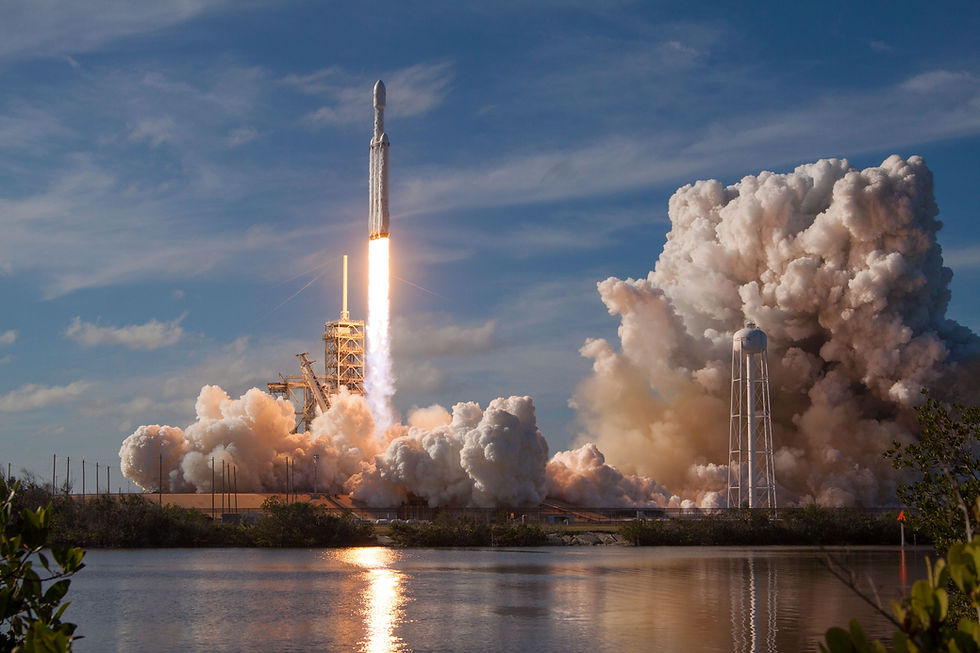
When a rocket lifts off from Earth, it does not rise politely. Whether under the banners of NASA or SpaceX, ascent begins with violence — calculated, disciplined, magnificent violence.
Earth does not release objects casually. It holds them with gravitational acceleration averaging 9.81 m/s². To break free of that hold requires more than desire. It requires thrust exceeding weight, sustained long enough to achieve escape velocity — approximately 11.2 kilometers per second. Anything less results in eventual return.
The physics is unforgiving, let me discuss it with you carefully.
Liquid oxygen and refined propellants are ignited in controlled combustion chambers. Rapid oxidation produces high-temperature, high-pressure exhaust gases. These gases are expelled through nozzles at extreme velocity, generating thrust in accordance with Newton’s Third Law: for every action, an equal and opposite reaction. The rocket is driven upward because matter is violently expelled downward.
But thrust alone is insufficient. Engineers must calculate atmospheric drag coefficients, structural load tolerances, and dynamic pressure peaks during transonic passage. There is Max Q — the moment of maximum aerodynamic stress — when vehicle velocity and atmospheric density combine to produce peak structural strain. Guidance systems adjust thrust vectors continuously. Stage separation occurs with precise timing to shed mass and increase efficiency. Orbital insertion requires exact velocity alignment relative to Earth’s curvature.
Ascent is not merely upward motion. It is a negotiation with physics.
And even with decades of research, simulations, redundancies, and billions of dollars invested, launches sometimes fail. Systems rupture. Engines misfire. Trajectories deviate. Human ascent is brilliant — but it is never effortless.
Honestly I commend the scientific minds behind such feats!
Watching such a launch, one cannot help but feel awe. Not only at the engineering, but at the resistance of creation itself. To leave Earth demands rupture — combustion, detachment, heat, velocity, strain.
And then Scripture speaks in a tone entirely different.
“In a moment, in the twinkling of an eye…”
— 1 Corinthians 15:52
The word translated “moment” carries the idea of an indivisible instant — something too small to be sectioned. No staging. No countdown. No ignition sequence.
There is no description of propulsion.
No mention of escape velocity.
No reference to overcoming gravitational constants.
The emphasis is not on force but on transformation: “this mortal must put on immortality.” Before there is relocation, there is transfiguration. Before ascent, there is alteration.
The difference is not technological. It is ontological. A rocket must overcome a field, but God sustains that field. Gravity is not an obstacle to the One who authored its constant. The curvature of spacetime does not resist the One who upholds all things by the word of His power. Physical law binds physical matter; it does not bind its Designer.
Human ascent requires energy expenditure proportional to mass and gravitational pull. Divine ascent requires no expenditure at all. It is not achieved through thrust but through authority.
When Scripture describes Christ’s ascension, it does not narrate combustion beneath His feet. There is no thermal plume, no sonic boom, no structural stress diagram. He is taken up. Reality yields without protest.
The simplicity is not weakness. It is sovereignty.
We tend to equate power with spectacle — with flame columns and shaking ground. Rockets teach us that leaving Earth is difficult. The gospel teaches us that translation into glory is effortless for God.
Not because Heaven is closer than we imagine, but because God is greater than we comprehend.
The same voice that said, “Let there be light,” without fusion reactors or stellar furnaces, will summon the redeemed without propulsion systems. Creation required no laboratory. Resurrection will require no launchpad.
Human progress is impressive precisely because it works within constraint. Engineers calculate within equations. Physicists respect constants. Scientists labor within measurable parameters. Their achievement is not diminished by this — it is dignified by it.
But divine action operates on a different plane. God does not calculate escape velocity. He defines velocity. He does not negotiate drag coefficients. He establishes atmospheric layers. He (God) does not require rupture to rapture His people.
He simply wills — and reality complies.
Perhaps that is why the apostle did not describe thunder or combustion at the rapture. He described immediacy. “In the twinkling of an eye.” The most delicate temporal measure becomes the language of cosmic transition.
Rockets rupture the sky to escape the earth. God will not rupture creation to bring His people home.
He will speak. And in that uncut instant — without fire, without strain, without structural stress — mortality will give way to immortality, and gravity will not object.
The rupture belongs to human ascent. The rapture belongs to God and His people.
I pray for you my friend, that in the name of Jesus, as mighty things are effortless for God, let blessings, health, prosperity, and fruitfulness, become effortless for you from today.
Have mercy.


Comments